





Unmet needs in current continuous glucose monitoring (CGM) solutions
Dr. Bruno Grassi Corrales
The video, recorded on November 25, 2025, analyzes the role of continuous glucose monitoring (CGM) as a fundamental tool in diabetes management and examines the persistent challenges that prevent therapeutic goals from being achieved.

Dr. Bruno Grassi Corrales is a leading specialist with extensive experience in the management and treatment of diabetes.
- Specialist in Internal Medicine, Clinical Nutrition, and Diabetology.
- Head of the Type 1 Diabetes Team at the UC-Christus Health Network.
- Director of the Clinical Nutrition and Adult Diabetology Residency Program.
- Assistant Professor at the School of Medicine of the Pontifical Catholic University of Chile.
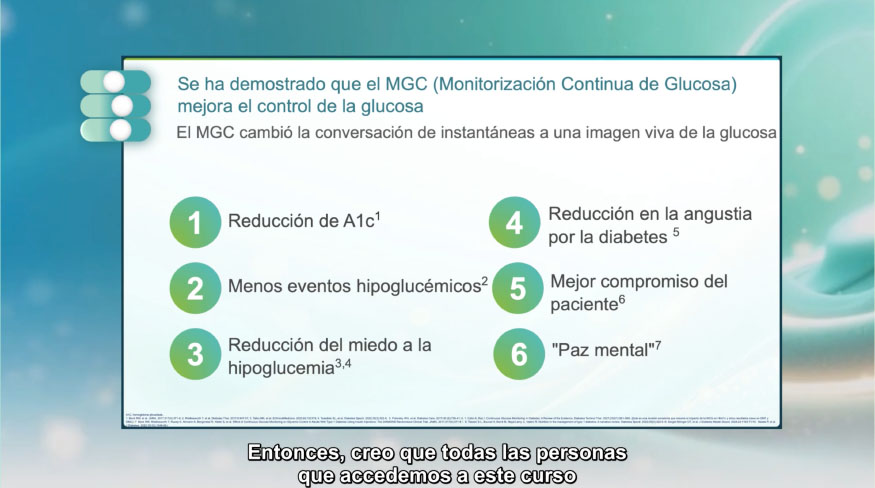
The video highlights the importance of continuous glucose monitoring as a powerful tool in diabetes management, which has enabled a transformation from point-of-care blood glucose testing to a continuous interpretable line. This has been consistently associated with a reduction in glycosylated hemoglobin levels, demonstrated in multiple studies and populations, along with a reduction in hypoglycemia events, fear of hypoglycemia, and diabetes distress. 1-7
In many cases, patients become more committed to their care, and some descriptive studies report that it allows them to achieve greater peace of mind. Dr. Grassi emphasizes the importance of integrating this practice as part of modern diabetology and endocrinology.
Continuous monitoring has been shown in numerous studies to consistently and significantly reduce glycosylated hemoglobin and, in both type 1 and type 2 diabetes, increase time in range and reduce time in hypoglycemia. 1-9
Despite all this, the clinician reports that many challenges remain for patients. The first is the transition from a time when little information was available to one in which an excess of data limits its proper management by patients and healthcare professionals.
Another challenge is the planning gap, when patients fail to take preventive action to avoid glycemic disturbances. This new era of information overload places a heavy cognitive burden on patients.
Finally, fear of hypoglycemia remains a challenge, potentially leading to high anxiety in some patients. 10-1
The study published in Diabetes Care 2025 sought to determine the limitations in achieving glycemic control in users with continuous monitoring and the persistence of severe hypoglycemia. With nearly 1,000 participants, it showed the significant gap in patients who still fail to achieve control goals in manual systems, whether injections or insulin pumps. Certainly, the number of patients affected is greatly reduced in automated systems, but there are still 25-30% who do not achieve their goals and 15-20% for whom severe hypoglycemia remains a problem.
The study concludes that, despite having tools such as continuous monitoring, there is still a significant percentage of patients who do not achieve control targets and report hypoglycemia. Hypoglycemic events are common even when time-in-range goals are achieved. 11,15
Trend arrows are traditional monitoring tools that provide retrospective information, indicating the rate at which glucose is falling to a certain point; the steeper the slope, the faster blood glucose will change. The doctor's opinion is contrary to patients making decisions based on trend arrows, as they often make the wrong decisions, particularly with upward trend arrows. It is important to have a tool that provides this information predictively. Another problem with traditional monitoring is alarms, which only shorten the duration of hypoglycemia but do not prevent it from occurring.
There is a need for a tool that anticipates hypoglycemia, giving the patient time to avoid it.
16-18
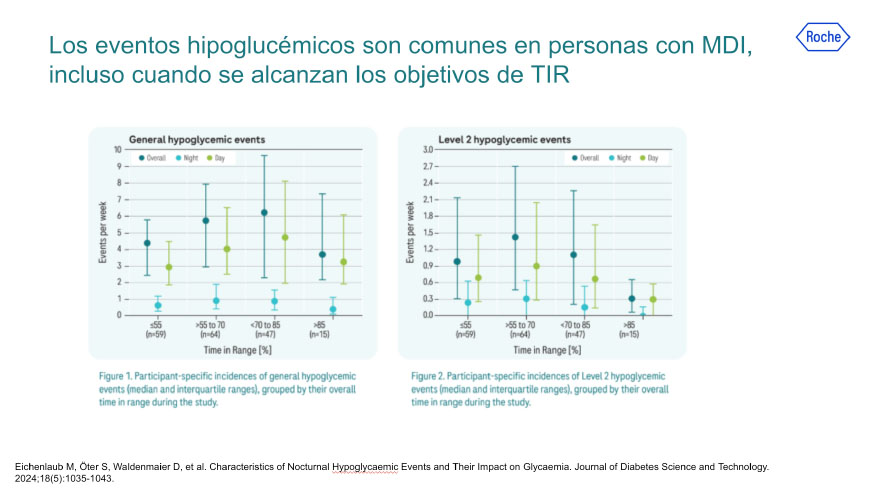
Eichenlaub M, Öter S, Waldenmaier D, et al. Characteristics of Nocturnal Hypoglycaemic Events and Their Impact on Glycaemia. Journal of Diabetes Science and Technology. 2024;18(5):1035-1043.
CGM users need to be provided with more advanced data-driven solutions to enable proactive management, reduce diabetes distress and alarm fatigue, and improve sleep quality and quality of life.13,16,19
To conclude the presentation, the clinician showed the results of a study using real-life data from 206 continuous monitoring users with type 1 diabetes in Germany. These users were surveyed on diabetes suffering scales and presented with a hypothetical situation in which they would have a monitoring algorithm to predict glucose levels up to two hours in advance, in order to assess the impact on different psychosocial spheres.
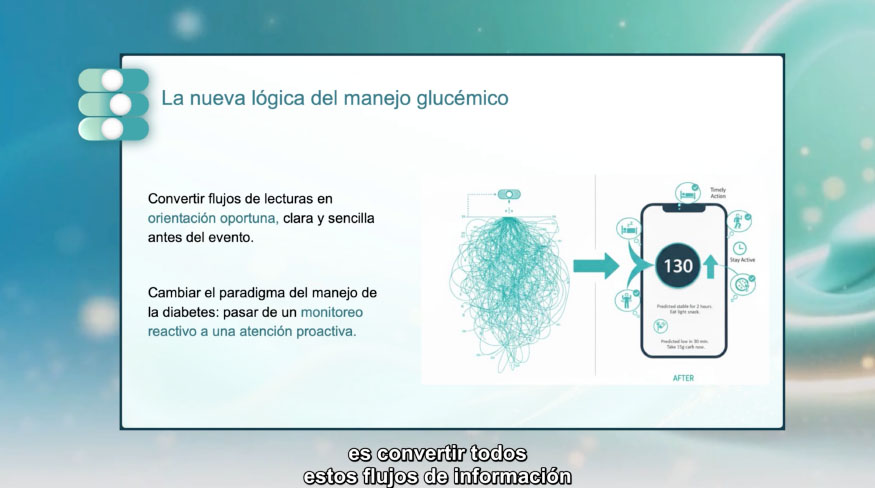
The results showed that if patients had access to this prediction, they would potentially experience improvement by knowing their future glucose levels and reducing their fear of hypoglycemia. Predictive tools have great potential for those who must make constant decisions about their diabetes. Therefore, the new logic of glycemic management must evolve to convert the flow of information into data that is easy for patients to understand, with reliable information and accurate predictions that allow them to make timely and preventive decisions to improve their quality of life and achieve proactive diabetes care.20
Finally, Dr. Bruno Grassi concluded the video by inviting attendees to stay tuned for new updates.
Referencias
- Beck RW, Riddlesworth T, Ruedy K, Ahmann A, Bergenstal R, Haller S, et al. Effect of Continuous Glucose Monitoring on Glycemic Control in Adults With Type 1 Diabetes Using Insulin Injections: The DIAMOND Randomized Clinical Trial. JAMA. 2017;317(4):371-8.
- Riddlesworth T, et al. Diabetes Ther. 2017;8:947-51.
- Talbo MK, et al. EClinicalMedicine. 2023;62:102119.
- Tessier S-L, Bouvet H, Berré M, Naya-Lamy C, Valéro R. Nutrition in the management of type 1 diabetes: A narrative review. Diabetes Spectr. 2022;35(3):322-6.
- Polonsky WH, et al. Diabetes Care. 2017;40 (6):736-41.
- Cahn A, Raz I. Continuous Glucose Monitoring in Diabetes: A Review of the Evidence. Diabetes Technol Ther.
2021;23(S1):S61-S69. - Sergel-Stringer OT, et al. J Diabetes Metab Disord. 2024;23:1163-71/10. Natale P, et al. J Diabetes. 2023;15(12):1048-69.
- Lu J, et al. Continuous Glucose Monitoring in Type 1 Diabetes, Type 2 Diabetes, and Diabetes During Pregnancy: A Systematic Review with Meta-Analysis of Randomized Controlled Trials.Diabetes Technol Ther. 2025;27(2):147–160.
- Tan YY, Suan E, Koh GCH, Suhairi SB, Tyagi S. Effectiveness of continuous glucose monitoring in patient management of Type 2 Diabetes Mellitus: an umbrella review of systematic reviews from 2011 to 2024. Arch Public Health. 2024 Dec 2;82(1):231.
- Markov AM, et al. J Diabetes Sei Technol, 2023;19 (6) :995-1011.
- Laffe LM, et al Limitations in Achieving Gycemis Targets From OGM Data and Persistence of Severe Hypoglycemia, in Adults With Type 1 Diabetes Regardess of Insuin Delivery Method, Diabetes Care. 2025:48(2-273-279.
- Rermann D, et al. Feaz of Bypoglycenia and Diabetes Distress: Expected Reduction by Glucose Erediction, Journal of Diabetes Sclence and Technology, 2024;18(5):1027-1034.
- Barnard-Kelly KD, et al. Real-world experiences of curzently available CGM to improve uptake and benefit. Diabet Med. 2024 Aug: 41(8).
- Polonsky N8, Fisher I, Bessler D, et al. Journal of Diabetes and its Complications. 2020:34 (7).
- Eichenlaub M, Öter S, Waldenmaier D, et al. Characteristics of Nocturnal Hypoglycaemic Events and Their Impact on Glycaemia. Journal of Diabetes Science and Technology. 2024;18(5):1035-1043.
- Ziegler R, von Sengbusch S, Kröger J, Schubert O, Werkmeister P, Deiss D, et al. Therapy Adjustments Based on Trend Arrows Using Continuous Glucose Monitoring Systems. J Diabetes Sci Technol. 2019 Jul;13(4):763-773.
- Horwitz DL, Klonoff DC. New Technologies for Glucose Monitoring and Insulin Administration. Chichester, UK: John Wiley; 2017.
- Clinical and Laboratory Standards Institute. Performance metrics for continuous interstitial glucose monitoring; approved guideline. POCT05-A. Wayne, PA: Clinical and Laboratory Standards Institute; 2008.
- Pickup, J. C., et al. Diabetes Care 38, 544–550 (2014). 10.2337/dc14-1855.
- Ehrmann et al EASD Diabetologia 66 (Suppl 1), 1-536 (2023) doi: 10.1007/s00125-023-05969-6. Presented at 59th EASD Annual Meeting in Hamburg, October 2023.