


From Trend to Prediction:
How AI in CGM Transforms Data into Decisions
HIGHLIGHTS – SIMPOSIUM
Between October 29 and 31, 2025, Rio de Janeiro hosted the 25th Congress of the Brazilian Diabetes Society (SBD),
the largest and most important national event in the field, bringing together diabetes experts from Brazil and around the world to discuss the latest advances and innovations in the management and treatment of the disease.
During the congress, Accu-Chek SmartGuide was launched, a continuous glucose monitoring (CGM) system that integrates predictive algorithms capable of anticipating hypoglycemia and hyperglycemia events. The technology represents a significant advance in diabetes management, offering patients and healthcare professionals a more accurate, initiative-taking, and personalized decision support tool.
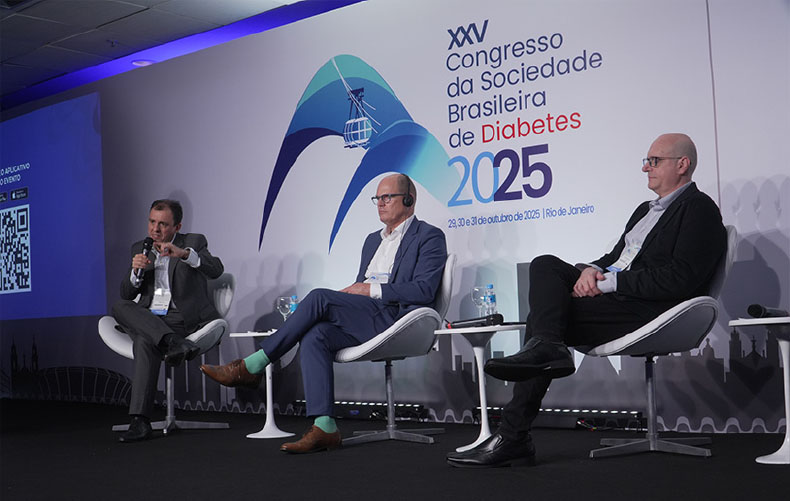
Dr. João Salles, Dr. Stefan Golz y Dr. Márcio Krakauer
The scientific symposium brought together three experts, Dr. Stefan Golz from Germany, Dr. Márcio Krakauer and Dr. João Salles from Brazil, who discussed how glucose prediction integrated into CGM redefines the clinical management of diabetes.
Below are the main highlights of the symposium.
From data to decisions: the evolution of CGM and the role of glucose prediction in clinical practice
Dr. Stefan Golz
– Diabetologist in Esslingen;
– Member of the German Diabetes Society (DDG);
– Memberof the national
committees for guidelines on type 1 diabetes therapy and diabetes in the elderly;
– Vice president of the ADBW.
Dr. Stefan began the session by reviewing the evolution of CGM over the past two decades. Technology has replaced spot measurements with dynamic, continuous monitoring, leading to consistent reductions in HbA1c, lower frequency of hypoglycemia, and significant psychosocial gains, such as greater confidence, less fear of hypoglycemia, and reduced stress associated with diabetes. However, significant barriers persist. Many patients are unable to translate the available data into appropriate therapeutic actions. Cognitive overload, alarm fatigue, anxiety about hypoglycemia, and difficulty interpreting trend arrows are factors that underpin the so-called “paradox of data abundance.”
According to the expert, the current model is still predominantly reactive. Alarms are triggered when the event is already underway, often requiring excessive and belated corrections. The expert highlighted the need to migrate to a predictive model, in which CGM not only reports values but also anticipates risks. Based on this critical analysis, Dr. Stefan brought focus to the central concept of the discussion: the transition from reactive monitoring to predictive management.
The Accu-Chek SmartGuide represents this new generation of smart CGMs. The system combines a high-accuracy sensor (MARD 9.2%) with the SmartGuide Predict module, which consists of three features: (1)

Low Glucose Predict

Night Low Predict

Glucose Predict
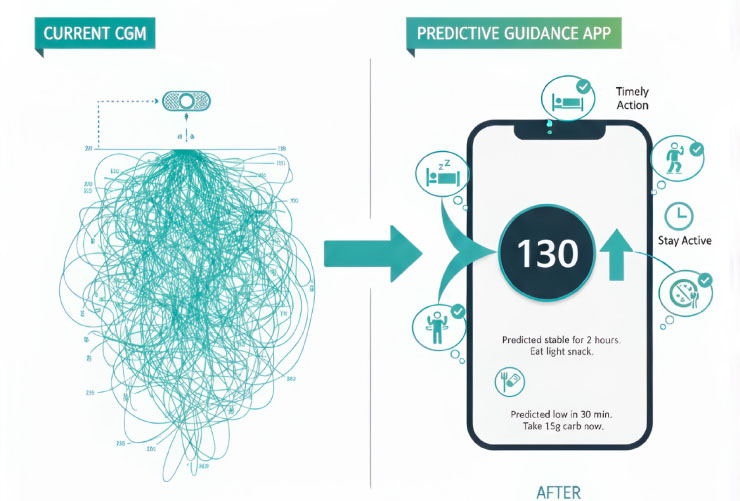
The algorithms were validated in more than 64,000 days of clinical and real-world data, demonstrating over 99% accuracy in predicting imminent hypoglycemia and over 94% accuracy in 120-minute glycemic predictions. (2)
The clinical case presented by Dr. Stefan illustrated the applicability of the system. A 75-year-old patient with post-pancreatectomy pancreatic diabetes presented with elevated HbA1c, fear of hypoglycemia, and little confidence in previous sensors. In just 20 days of using SmartGuide, Time in Range (TIR) increased from 1% to 15%, and time in severe hyperglycemia (TaR 2) decreased from 66% to 13%. After two months, the TIR reached 33%, and the time in severe hyperglycemia reduced to 7%. The patient reported substantial improvement in sleep quality and a significant decrease in fear of hypoglycemia.
For the specialist, this integration between accuracy and prediction transforms CGM from an observation tool into an active clinical decision-making instrument. “We are evolving from data to decision-making,” he concluded.
First clinical cases with Brazilian patients
Dr. Márcio Krakauer
– Presidente da Associação de Diabetes do ABC (ADIABC);
– Coordinator of CIATEM;
– SBEM Artificial Intelligence in Endocrinology and Metabology Commission;
– Coordinator
of the Department of Technology, Digital Health, and Innovation at the Brazilian Diabetes Society;
– Co-founder of
G7Med Educação;
– Physician at the Diabetes League of the ABC Medical School.
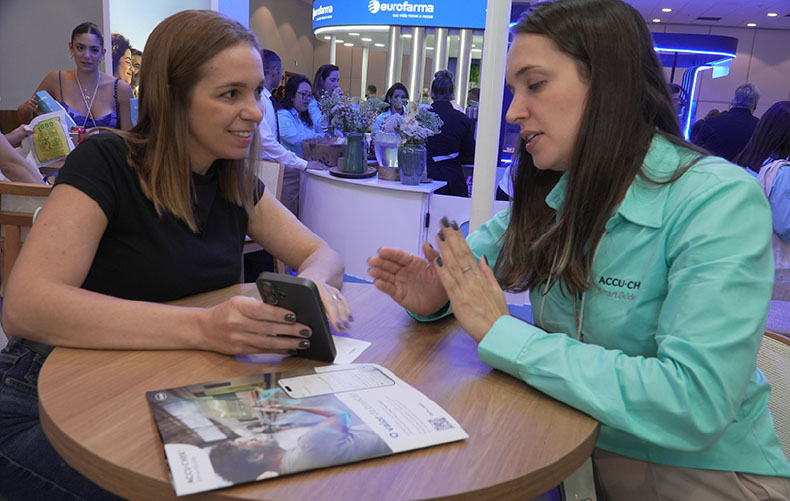
Dr. Márcio Krakauer presented the initial results of using Accu-Chek SmartGuide in Brazilian patients. For the specialist, the system's main distinguishing feature is that it enables shared decision-making, in which the patient takes preventive action based on predictions, while the doctor interprets trends and adjusts treatment. “AI does not replace doctors; it expands their capacity to respond,” he said.
During the session, Dr. Márcio presented the following case: 39-year-old patient, late-onset autoimmune diabetes (GAD positive), undergoing intensive insulin therapy. The app issued a high-risk alert for nocturnal hypoglycemia at 10:12 p.m., with blood glucose still at 100 mg/dL. The patient followed the recommendation to ingest a slow-absorbing carbohydrate and he spent the night without hypoglycemia for the first time.
The data showed a TIR of 86.5% and a considerable reduction in the time spent on hypoglycemia. The patient reported greater confidence in the suggested behaviors and important behavioral learning, expressing that the prediction helped her understand how to act preventively. Dr. Márcio emphasized that the case highlights the educational dimension of SmartGuide, which transforms the user experience into behavioral learning, reducing diabetes distress and strengthening patient self-management. “We are looking at a tool that teaches, guides, and supports decision-making, both for patients and professionals”, he concluded.
From unpredictability to control:
applicability of
prediction in patients with DM2
Dr. João Salles
- Director of the Department of Medicine at Santa Casa de São Paulo Central Hospital;
- Adjunct
Professor and Coordinator of the Endocrinology Discipline at the Faculty of Medical Sciences of Santa Casa de
São Paulo;
- President-Elect of the Brazilian Diabetes Society 2026-2027.
Closing the symposium, Dr. João Salles discussed the usefulness of SmartGuide in patients with DM2, especially those who fear hypoglycemia or have low adherence to insulin therapy. The clinical case presented was that of a 65-year-old male patient, an engineer, with type 2 diabetes mellitus (DM2) for 26 years, diagnosed at age 39, without significant obesity, but with marked central adiposity and a history of lipotoxicity and insulin resistance. The patient had achieved good glycemic control with multiple oral therapies and GLP-1 agonist, but had an intense fear of insulin, exacerbated by its association with maternal death due to hypoglycemia.

The patient was reintroduced to insulin combined with GLP-1, now monitored by SmartGuide. Initially, nocturnal hypoglycemia caused concern, but once he understood the predictive alerts, he began to use the app's guidelines to take preventive action. The system enabled safer adjustments to food intake and insulin, reduced episodes of hypoglycemia, improved glycemic variability, and increased time in the target range. More than that, it promoted behavioral change: the patient began to recognize the impact of food on his blood sugar and said that he had “learned to predict the unpredictable”.
For the specialist, the resource gives patients with DM2 a sense of control that is often lost over the course of the disease. Prediction strengthens self-management, reduces emotional barriers, and transforms the patient into the protagonist of their own care. He concluded by emphasizing that technology has significant potential to facilitate the safe use of insulin in this population.
References:
- Mader JK, Waldenmaier D, Mueller-Hoffmann W, et al. Performance of a Novel Continuous Glucose Monitoring Device in PeopleWith Diabetes. Journal of Diabetes Science and Technology. 2024;18(5):1044-1051.
- Herrero P, Andorrà M, Babion N, et al. Enhancing the Capabilities of Continuous Glucose Monitoring With a Predictive App. Journal of Diabetes Science and Technology. 2024;18(5):1014-1026.